
 |
| St. Savior's Church Chora |
Istanbul is a city of never ending experiences. Here Roger
and I find a few real jewels among the Sultan’s treasures.
The Seven Hills Hotel with its delicious roof top seafood restaurant overlooking the Bosporus, a
horse-drawn phaetom ride through Bayukada in the Princes’ Islands just a
short breezy ferry trip from the city and what I consider the highlight of our visit - a small 1300th century church containing some of the finest Byzantine
mosaics and frescoes – St. Savior’s Church Chora, in Turkish - Kariye Műzesi.
The church is simply the most beautiful I have ever seen.
Originally known as the Church of the Holy Savior Outside the
Walls, it is a little off the tourist track; thank goodness after the crowds at
Topkapi Palace!
 |
| Plaza at Chora Church |
Tucked in a quiet neighborhood on one side of a beautiful tree canopied
plaza near the city’s western walls, it is a small island of tranquility in the
middle of Istanbul’s chaos. A few street vendors sell the obligatory souvenirs
but there is a delightful collection of very nice shops. On the restaurants’ patios locals sip their Turkish coffees leisurely enjoying the pleasures of a quiet
afternoon. But for me, the treasure here is the ancient church.
 |
| On the southern wall of the arch of the aspe (the semi circular recess of the sanctuary) is the Virgin Mary with the Child Jesus on her lap. |
 |
| The main body of the Church |
“Chora” means “in the country” which is where the church was when the monastery it was attached to was built outside the city’s walls. The church you see today dates from the 11th century. Theordore Metochites, the auditor of the treasury
under Emperor Andronikos II (1282-1328) and noted theologian, philosopher and
poet, added the mosaics and frescoes in the 1300s. The mosaic, above the door
to the nave (the center aisle of the church), depicts Theordore presenting the Chora Church to Christ.
 |
| Theordore Metochites presenting the Chora Church to Christ |
The original monastery was destroyed by an earthquake during the
reign of Justinian (527-565) and rebuilt as a basilica and then restored again in
843. During the 11th century another round of extensive renovations
were funded by Alexios Komenos, Byzantine Emperor from 1081 -1118. Then from 1315-1321, the church was
enlarged and redecorated with the beautiful mosaics by Metochites.
 |
| The Last Judgement In the vaulted dome in front of the arch of the aspe is depicted the Last Judgement. This picture is only the left hand side of the mosaic. On the far right is the Virgin Mary in the dark cloak. Seated are the twelve Apostles with angels behind them. |
In 1511, the Chora Church was rededicated as a mosque after Constantinople (Istanbul) fell to the Turks. Praise Allah that it was considered
blasphemous by Muslims to destroy these pieces of art because they depicted people.
They just covered up the images with plaster and wood facades. It wasn't until 1948 that the Byzantine Institute of America began the meticulous restoration of these masterpieces and the mosque became a museum.
Location: Kariye Camii Sokak, Edirnekapi, Phone: 0212-631 9241
My pictures can only give you a sense of the grandeur.
 |
| Visit of the three Maji On the right is King Herod sitting on his throne with a guard standing near. The three Maji are standing in front of the King informing him that a child is born who will lead Israel. On the left are the three Maji astride their horses. |
 |
| Joseph brings the Virgin Mary to his home |
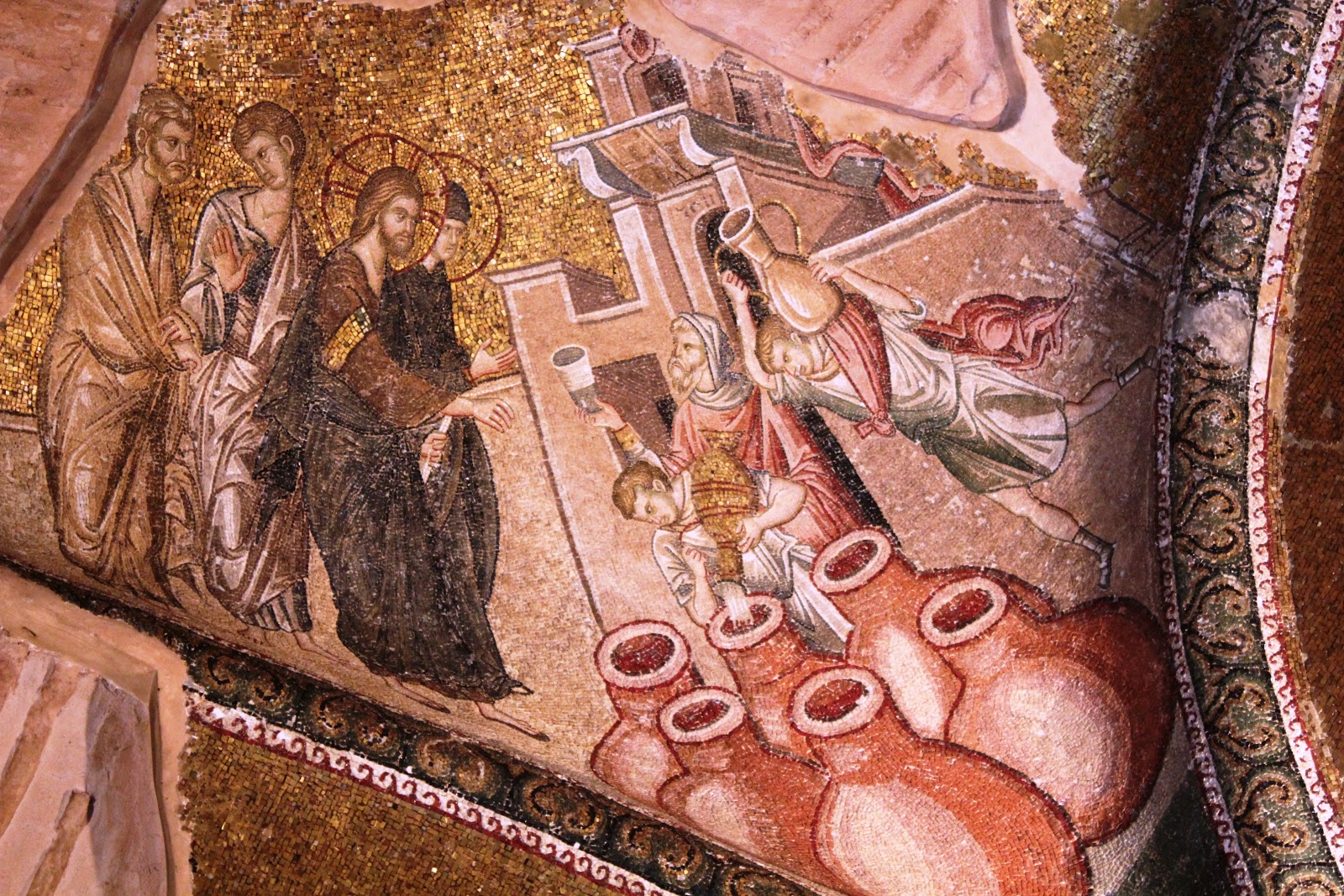 |
| Miracle at Cana At a wedding ceremony in Cana Jesus turn water into wine. |
 |
| Underneath the wall of the aspe are depicted Saint Basil, Saint Gregory and Saint Cyril of Alexandria |
 |
| Virgin Mary, Child Jesus and Angels In the middle of the dome in the Parecclesion (a side chapel) are the figures of the Virgin Mary holding the Child Jesus as he gives a blessing with his two hands. Surrounding them are twelve angels |
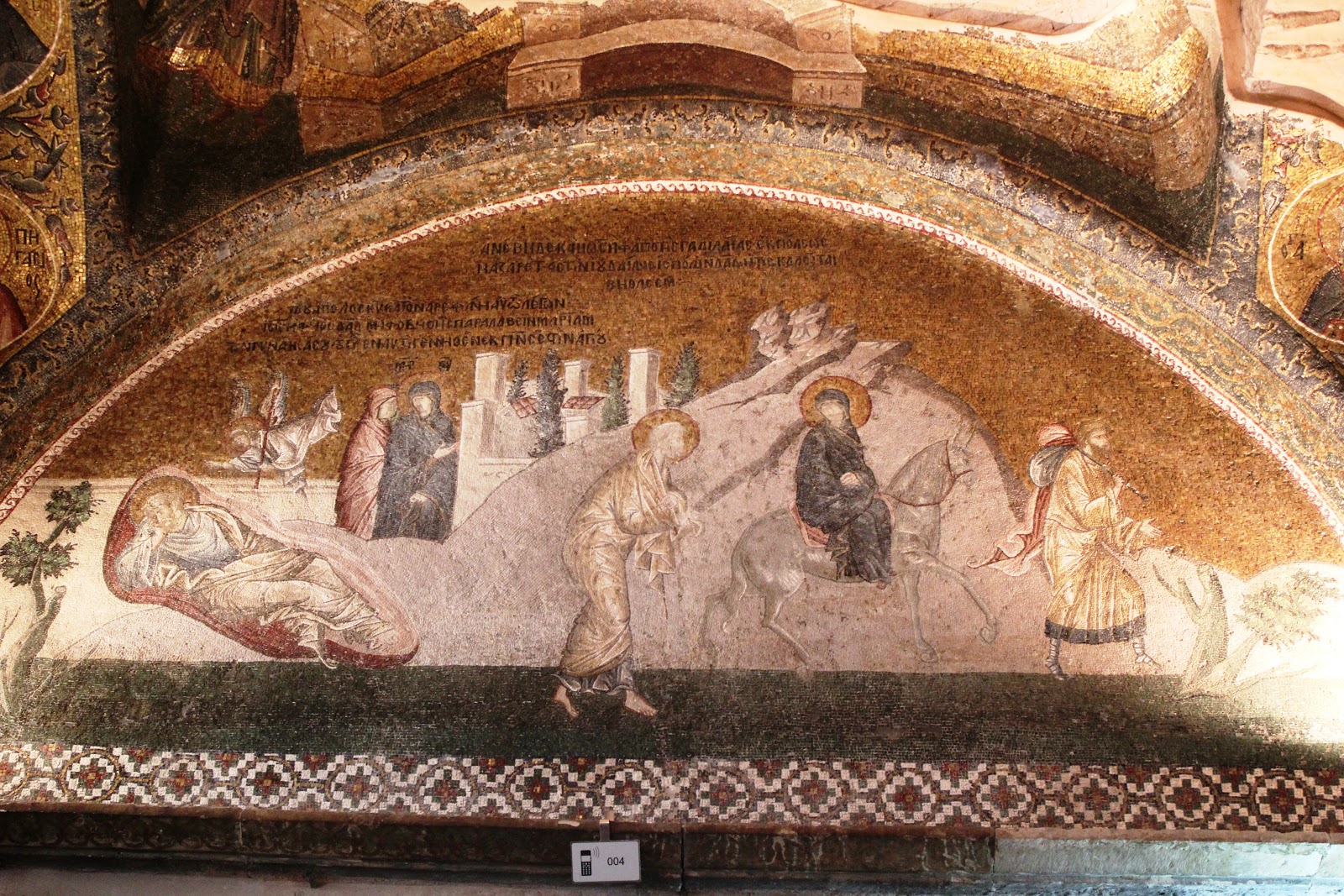 |
| The Trip to Bethlehem On the left Joseph is sleeping when an angel approaches him to tell him the good news. On the right is the Virgin Mary astride a donkey accompanied by another family traveling to Bethlehem. |
 |
Jesus Christ give his blessing while holding the Holy Book |
 |
| Enrollment for taxation Cyrenius, the Governor of Syria, is seated on the left. A Roman soldier confers with Joseph as the Virgin Mary looks on. |
 |
| Birth of Jesus In the middle of the mosaic Mary is seen awake and resting after giving birth to Jesus. Above Mary a light shines down over Jesus who is wrapped in swaddling clothes. On the right an angel talks to shepherds. At the bottom Joseph is sitting. On the left the bathing of Jesus is depicted. |
 |
| The Annunciation The Virgin Mary receives the news of her pregnancy from an Angel. In front of the house stands her mother Anne who is praying to God. |
 |
| Presentation of Virgin Mary On a decorative medallion in the middle of the vault three priests sit and Joachim, holding the Virgin Mary, presents his daughter to them. |
 |
| John the Baptist, Jesus and Satan On a medallion on the northern side of the church John the Baptist shows Jesus to the people standing behind him on the shores of the River Jordan. On the right side is Satan. |
 |
| The Death of the Virgin Mary In the nave of the church above the entrance door is the death scene of the Virgin Mary. In the middle is Mary lying on a catafalque. On both sides are the apostles, clerical dignitaries and women from Jerusalem. Jesus holds a baby in his arms symbolically representing the soul of the Virgin Mary. Above Jesus are angels. |
 |
| Mary's marks her choice of husband Mary is seating in front of 12 sticks inside the cyborion from which she must mark her choice of husband. Chief Priest Zaccharian is praying on his knees. |
 |
| In the middle of the vault is a flying angel carrying a snail representing the"Cosmos" and "Paradise." This is the first time in Byzantine art that a snail is used to depict "Paradise." |


Thanks for sharing you marvelous pictures. Mrs. C. and I visited Turkey earlier this year and we were amazed by the country, its people and its history.
ReplyDeleteI am so glad you enjoyed . . . I think I could Istanbul every weekend and never get bored!!!
DeleteThe pictures are fabulous. Thank goodness they did such a good job on the restorations. The mosaic and paintings are far more beautiful than what you can see in Egypt's Valley of the Kings (Of course, those are much older.) Thanks for sharing. Great post! :-)
ReplyDeleteI was not kidding when I said this small out-of-the-way church was my most favorite place in Istanbul. I could go back in a minute and spend a whole day there. Glad you enjoyed.
DeleteThis comment has been removed by a blog administrator.
ReplyDeleteI am headed there. I will look for this church. Thanks for writing about it.
ReplyDeleteDon't miss it! It is a treasure. If you want any other pointers, I have additional posts on our travels to Istanbul and Ephesus,Turkey. Look on the right had side of the page for the "word cloud" table of contents and select Turkey Travel and all those posts will come up. Enjoy your trip.
DeleteThanks for the splendid pictures, I'm a teacher and I will use the last one in class tomorrow, if you don't mind. By the way, it is no snail. It is the end of time, the show is over and this angel is rolling up the cloth with the sun, moon and stars.
ReplyDeleteJoris
Hope your class enjoys the photo. The information regarding the ":snail" was taken from a book I purchased on the church. I like your idea better!
DeleteThis comment has been removed by a blog administrator.
ReplyDeleteThis comment has been removed by a blog administrator.
ReplyDeleteThis comment has been removed by a blog administrator.
ReplyDeleteThis comment has been removed by a blog administrator.
ReplyDeleteThis comment has been removed by a blog administrator.
ReplyDeleteOften times, guests will mention a hiccup that occurred during their stay. Maybe a bed wasn’t made, a light bulb isn’t working, or it’s a little hotter than they expected and there was no fan provided. That can be a make or break moment for that guest’s whole trip and will color the way they experience the rest of their vacation. beach investment property
ReplyDeleteIf you have a vacation rental website, then online marketing is even more crucial for getting noticed. If you don’t have your own website, and have only listed your rental on platforms like Airbnb or VRBO, you can still benefit from a concerted effort to get your listing in front of people. buying a beach rental property
ReplyDelete"From Mayan ruins and lush jungles to pristine Pacific Coast surf beaches and the seediness of Tijuana — and everything in between! Discover Mexico City’s vibrant energy and artsy, graffiti-filled neighborhoods, learn about the Mayan civilization at Chichen Itza, and gorge yourself on delicious tacos, tostadas, and tamales (to name a few items from Mexico’s very long list of traditional dishes).
ReplyDelete" house for the weekend
The work of Albert Einstein and the ideas of Stephen Hawking differ when it comes to the even theoretical possibilities of time travel to the past. However, both points of view can be accommodated by invoking the concept of parallel worlds. It's a case then of having your time travel cake and eating it too but without fear of creating a paradox tummy ache. Hotel
ReplyDeleteThis is what I consider to be essential items for any traveler/backpacker. These are items which I have used in my past travels, and have served me well. Travelocity
ReplyDeleteThis is what I consider to be essential items for any traveler/backpacker. These are items which I have used in my past travels, and have served me well. Europa-Road tengeri szállítmányozás
ReplyDeleteI discovered your site website on google and check a couple of your early posts. Preserve the really good operate. I merely extra encourage Feed to my MSN News Reader. Looking for forward to reading far more within you later on!… 먹튀
ReplyDeleteI just couldn’t leave your site prior to suggesting that I extremely loved the usual info a person provide in your guests? Is gonna be again often to investigate cross-check new posts. 먹튀
ReplyDeletehttp://arabiantalesandotheramazingadventures.blogspot.com/2012/11/istanbul-travel-st-saviors-church-chora.html
ReplyDeleteYou will soon learn how to travel better for less, write it off your taxes, get paid to do it and make a fortune sharing it with others. We are a 6 year old publicly traded company eclipsing 1 billion this year and growing more than 400%. sunglasses spot
ReplyDeleteYou would like to find as being a true man, not a counterfeit. 918kiss kiss918 apk download
ReplyDeleteYou would like to find as being a true man, not a counterfeit. 토토사이트
ReplyDeleteI found your blog web site on google and test a few of your early posts. Continue to maintain up the superb operate. I just extra up your RSS feed to my MSN Information Reader. Searching for ahead to reading more from you later on!… 토토사이트
ReplyDeleteBinary options has become increasingly popular. Tradesmarter is one of the oldest binary options trading platform and is regulated as well. 파워볼사이트
ReplyDeleteI discovered your site website on google and check a couple of your early posts. Preserve the really good operate. I merely extra encourage Feed to my MSN News Reader. Looking for forward to reading far more within you later on!… 파워볼사이트
ReplyDeleteAw, this was a actually good publish. In principle I want to set in producing like this furthermore – taking time and actual work to make an excellent article… but what can I say… I procrastinate alot and not at all seem to get some thing accomplished. 먹튀검증 추천
ReplyDeleteThrough this post, I know that your good knowledge in playing with all the pieces was very helpful. I notify that this is the first place where I find issues I've been searching for. You have a clever yet attractive way of writing. 먹튀검증커뮤니티
ReplyDelete이 특별한 서류는 훌륭합니다. 그리고 나의 배우자와 나는 당신이 이것에 배치 한 각각의 공연을 즐깁니다. 정말 유용한 곳이 될 거라고 확신합니다. 나는 또한 기뻤다. 잘 했어! 먹튀검증
ReplyDeleteMany within the comment attempts on my blogging site have been completely crafted employing automated software programs. The bottom line with respect to commenting software is this. Its nothing at all more than an arms race involving people that utilize it and search engines like yahoo. mexican restaurant
ReplyDeleteYou have a good point here!I totally agree with what you have said!!Thanks for sharing your views...hope more people will read this article!!! 먹튀검증사이트
ReplyDeleteThis sort of thing needs to happen! Simply letting the quota happen isn’t acceptable. This will help you stay above the curve. superslot เครดิตฟรี50 ยืนยันเบอร์
ReplyDeleteThanks for your marvelous posting! I actually enjoyed reading it, you could be
ReplyDeletea great author.I will remember to bookmark your blog and will
토토사이트
eventually come back from now on. I want to encourage you to continue your great
writing, have a nice weekend!
A very awesome blog post. We are really grateful for your blog post. combat, law enforcement You will find a lot of approaches after visiting your post. I was exactly searching for. Thanks for such post and please 스포츠토토
ReplyDeletekeep it up. Great work
I have read a few of the articles on your website now, and I really like your style of blogging. I added it to my favorites site list and will be checking back soon. Please check out my site as well and let me know what you think. Autoankauf Kassel
ReplyDeleteReally satisfied with all the information I have found in this article. It gives immense knowledge on physical education, it is very helpful and quite generous to spread a good message. The author has done a brilliant job on summing all the points here. You just made a new fan UFCCASINO
ReplyDeletewith your writing skills. Cheers!
This is a great source. But I hope you keep posting and updating this site. Have a great day. 먹튀검증
ReplyDeleteNice work!I’ve read most of your articles and 부산오피
ReplyDeleteI love to read them at your site as you got best stuff, I have ever seen Admin We Like Dubai junk You always post amazing things like that.
핸디캡이 +5점이지만 스코어가 5점차로 끝나게 된다면 이는 무효판정을 받는다는 것입니다. 또한 예외로 경기가 취소되거나 진행하지 않을 경우에도 적중특례에 해당됩니다. 야구와 농구의 경우 모든 토토사이트가 규정이 다릅니다. 언/오버의 경우는 모두 전/후반 또는 9이닝이 끝난 후 연장 유뮤에 상관 없이 결과처리 되지만 핸디승/패와 일반 승/패 같은 경우는 모든 사이트의 규정이 다릅니다
ReplyDelete안전놀이터 .
If you have business travel to London, you need to read this article. In this article you will discover why the London riots created a greater business travel threat than a terrorist attack. We will examine the threat posed by the London riots and demonstrations, terrorist attacks and resulting travel delays, disruptions and changes. At the end of this article, you will have a specific understanding of the required business travel management response and awareness as to why this will happen again. The London riots and demonstrations has resulted in one of the largest business travel disruptions of 2011. flugradar live
ReplyDeleteHello.This article was really remarkable, especially because I was investigating for thoughts on this matter last Saturday. 먹튀검증
ReplyDeleteCan easily how important it's always to make a clean and additionally tidy doing business environment. PestoClean feature professional work cleaning about the daily, weekly or each month basis. Our offerings are flexible consequently they are adapted for the particular standards. We might help early mornings, late evenings and also on weekends. Cleaning for the building may be possible regularly or it is typically done like one-off housecleaning or one-time housecleaning whichever suits what you want. You can pick from among all the services that we all offer and get for this cleaners. cleaning services dubai
ReplyDelete2018년 런칭한 RT(레드타이거)슬롯은 최근 슬롯 게임 이용자들에게 많은 사랑을 받고 있습니다. 본사 이벤트 평일3% 주말5% 외에 담당자 쿠폰으로 최대 10%의 추가 보너스를 지급하고 있습니다. 믿고 쓰는 우리카지노 계열은 당연 먹튀가 없으며 높은 배당이 잘 터지는 곳 중에 하나입니다. 그 외에도 SA슬롯 마이크로밍 슬롯 등 다양한 슬롯게임을 즐기실 수 있습니다. 퍼스트카지노는 (구)개츠비카지노의 후속인 우리카지노 계열입니다슬롯사이트추천.
ReplyDeleteI’ve been absent for a while, but now I remember why I used to love this website.
ReplyDeleteThanks, I will try and check back more often. How frequently you update your site?출장안마
I'm often asked by travel writers to look at their website and make suggestions. Because of this I've discovered a lot of really great travel blogs 부달
ReplyDeleteI'm often asked by travel writers to look at their website and make suggestions. Because of this I've discovered a lot of really great travel blogs 아이러브밤
ReplyDeleteWith regards to the food, hotels usually hire chefs to do all the cooking – which does ultimately drive up the price of chain hotels.The cooking is uniform, and is usually undertaken by professionals who are loosely associated with the hotel. montreal travel restrictions
ReplyDeleteThanks for ones marvelous posting! I really enjoyed reading it, you might be a great author.
ReplyDeleteI will be sure to bookmark your blog and will eventually come back later on.
Try to check my webpage - 안마
Definitely, what a fantastic website and revealing posts, I definitely will bookmark your site.Have an awsome day!
ReplyDeleteClick here to chceck my blog :: 오피
I'm often asked by travel writers to look at their website and make suggestions. Because of this I've discovered a lot of really great travel blogs 야맵
ReplyDelete
ReplyDeleteThis article was written by a real thinking writer without a doubt. I agree many of the with the solid points
made by the writer. I’ll be back day in and day for further new updates.
Try to check my blog: 대구오피
(jk)
I am regular visitor, how are you everybody?
ReplyDeleteThis article posted at this website is in fact good
I
바카라
Since the time of Stone Age Man, when images of the animals and men hunting were first used to decorate the walls of cave, we have been fascinated by the captured image. Although it was not until the invention of photography that truly made this fascination into a form that everyone could enjoy regardless of artistic ability. People all over the world take pictures of themselves, relatives and friends, pets and landscapes whether or not there is a particular circumstance or reason. Nevertheless how much do we actually know about when it comes to photography? Below are some of the different kinds of photography that will help us learn more about the significance of the different way of taking photographs. dog photo college
ReplyDelete토토사이트 Thanks for this helpful article. Looking forward to having my portfolio. You can also read some of my great reviews about Best
ReplyDelete스포츠토토 thank you for this informative post.
ReplyDeleteThis is a topic that’s near to my heart… Thank you! Exactly where are your contact details though?| 바카라사이트
ReplyDelete온라인카지노 I must say, as a lot as I enjoyed reading what you had to say, I couldnt help but lose interest after a while.
ReplyDeleteThank you for sharing this information. I read your blog and I can't stop my self to read 온라인카지노your full blog. Again Thanks and Best of luck to your next Blog in future.
ReplyDeleteI really enjoy your web’s topic. Very creative and friendly for users. Definitely bookmark this and follow it everyday.온라인카지노
ReplyDeleteWe are really grateful for your blog post for giving a lot of information온라인카지노
ReplyDeleteVery nice article. I absolutely love this website.
ReplyDeleteThanks! 파워볼게임
Very appreciated post. Thank you for sharing this post with us. 릴게임
ReplyDeleteGood day! I could have sworn I’ve visited this site before but after looking at a few of the posts I realized it’s new to me. 파워볼게임
ReplyDeleteI have recently started a web site, the information you offer on this web site has helped me tremendously. Thanks for all of your time & work.
ReplyDelete경마사이트
경마
I have been absent for a while, but now I remember why I used to love this web site. Thank you, I will try and check back more frequently. How frequently you update your web site? 바카라사이트
ReplyDeleteI simply couldn’t go away your web site before suggesting that I actually loved the standard info a person provide for your guests? Is gonna be again steadily to inspect new posts. 토토
ReplyDelete바카라사이트 I was impressed by the good writing.Thank you.
ReplyDeleteIf you want to know the social graph game, come here!
Great article, totally what I was looking for.
바카라사이트 I’m really enjoying the design and layout of your website.
ReplyDeleteIt’s a very easy on the eyes which makes it much more pleasant for me to come
here and visit more often. Did you hire out a developer to create your theme?
Exceptional work!
토토 Hi there, I found your blog by the use of Google while looking for a related subject,
ReplyDeleteyour site came up, it appears good. I've bookmarked it in my google bookmarks.
I blog frequently and I truly thank you for your information. This article has really peaked my interest.
ReplyDeleteI will take a note of your site and keep checking for new details about once a week.
I subscribed to your Feed too. 온라인경마
You know therefore significantly when it comes to this subject, made me in my view consider it from numerous varied angles. 온라인경마
ReplyDeleteYour article reflects the issues people care about. 토토사이트
ReplyDeleteThank you for every other magnificent post. The place else could anybody get that type
ReplyDeleteof info in such a perfect way of writing? I have a presentation subsequent week, and I'm at the
search for such information.
click me here 온라인바카라
LG
I am very pleased to read this article. 카지노
ReplyDeletethank you for sharing this useful article , and this design blog simple and user friendly regards.온라인카지노
ReplyDeleteI’m really digging the template/theme of this blog. It’s simple, yet effective. A lot of times it’s very hard to get that “perfect balance” between usability and appearance.
ReplyDelete카지노
>cc
If you are looking for more information about digital photography jobs than you have come to the right place. With an increasing interest in digital photography today, photography careers are becoming a popular choice for career path. If you are interested in learning more about a career in photography than continue reading this article photobooth Dubai
ReplyDeleteright on our supermarket, i can buy some cheap protein bars which i always consume when doing workouts” f95zone games
ReplyDeleteIt’s really a great and helpful piece of info. I’m glad that you shared this helpful info with us. Please keep us up to date like this. Thanks for sharing.
ReplyDeleteカジノ
Just how can you have such abilities? I can not evaluate your abilities yet, yet your writing is outstanding. I thought of my instructions once again. I desire a professional like you to review my writing and also court my writing due to the fact that I'm actually interested concerning my abilities. 바카라사이트
ReplyDeleteI'd prefer someone's area. It happens to be superior to monitor all people verbalize in the heart and soul combined with readability within this theme important spot tend to be quickly diagnosed. Is Conan Exiles Cross Platform
ReplyDeleteWhen I initially commented I seem to have clicked the -Notify me when new comments are added- checkbox and from now on whenever a comment is added I recieve four emails with the exact same comment. Perhaps there is an easy method you can remove me from that service? Thanks a lot
ReplyDelete카지노
wep.
It is perfect time to make some plans for the
ReplyDeletelonger term and it’s time to be happy. I’ve learn this
post and if I may I wish to recommend you few attention-grabbing things or tips.
Maybe you can write subsequent articles regarding this article.
I want to read more things about it!
바카라사이트
wep
I savour, cause I found exactly what I was looking for.
ReplyDeleteYou’ve ended my four day lengthy hunt! God Bless you man.
Have a nice day. ByeClick Me Here슬롯
2YANGSKIE
You actually make it seem so easy with your presentation but I find this matter to be really something which I think I would never understand. It seems too complex and extremely broad for me. I am looking forward for your next post, I’ll try to get the hang of it! 야한동영상
ReplyDeleteI must express some appreciation to this writer just for bailing me out of such a incident. Right after looking through the internet and coming across advice that were not pleasant, I was thinking my life was done. Existing minus the approaches to the difficulties you have solved all through your main posting is a crucial case, and the kind which might have in a negative way damaged my entire career if I hadn’t encountered the website. Your main understanding and kindness in handling the whole lot was crucial. I don’t know what I would’ve done if I had not encountered such a solution like this. I am able to now look ahead to my future. Thank you very much for the expert and effective guide. I will not think twice to refer your web sites to any person who would like direction about this issue. 오피헌터
ReplyDeleteThanks for the sensible critique. Me and my neighbor were just preparing to do some research about this. We got a grab a book from our area library but I think I learned more clear from this post. I’m very glad to see such fantastic information being shared freely out there. 외국인출장
ReplyDeleteHaving read this I thought it was very enlightening. I appreciate you taking the time and energy to put this informative article together. I once again find myself spending a significant amount of time both reading and commenting. But so what, it was still worth it! 마사지
ReplyDeleteI all the time used to read piece of writing in news papers but now as I am a user of internet so from
ReplyDeletenow I am using net for articles or reviews, thanks to web.Click Me Here 슬롯사이트
1YANGSKIE
This article is provided to veterans who endure PTSD and Depression. It gives you summary information for the holistic
ReplyDelete슬롯머신
>wep<
'Have fun' is my message. Be silly. You're allowed to be silly. There's nothing wrong with it.
ReplyDelete파워볼사이트
What a fantabulous post this has been. Never seen this kind of useful post. I am grateful to you and expect more number of posts like these. Thank you very much.
ReplyDelete오피월드
Thank you so much for sharing this information, this will surely help me in my work and therefore, I would like to tell you that very few people can write in a manner where the reader understands just by reading the article once.
ReplyDelete사설경마
Hello mates, nice piece of writing and fastidious arguments
ReplyDeletecommented at this place, I am really enjoying by these.
Feel free to visit my blog - 사설경마
We like to honor numerous other world wide web websites around the web, even though they aren't linked to us, by linking to them. Beneath are some web pages really worth checking out. 립카페
ReplyDelete"Can I simply just say what a relief to find a person that genuinely understands what they are talking about on the internet.
ReplyDeleteYou definitely know how to bring an issue to light and make it important.
A lot more people ought to check this out and understand
this side of your story. It's surprising you are not more popular because you definitely have the gift."
마사지
Pretty great post. I just stumbled upon your
ReplyDeleteblog and wished to mention that I have truly loved surfing around your weblog posts.
In any case I’ll be subscribing for your feed and
I’m hoping you write once more soon!Also visit my site :: 인터넷경마
JIYANG
It's in fact very complicated in this full of activity life
ReplyDeleteto listen news on Television, therefore I only use internet for that purpose, and take the latest news.
카지노
What's up everyone, it's my first pay a quick visit
ReplyDeleteat this web site, and paragraph is really fruitful in favor of me, keep up posting these types of articles or reviews. 바카라
I really got a lot of information from your site. I want to help you too.
ReplyDeleteI hope you can visit my blog and get some good information like me. 일본경마
I ve recently been thinking the very same factor personally lately. Delighted to see a person on the same wavelength! Nice 먹튀보증업체
ReplyDeleteGreat items from you, man. I have be aware your stuff prior to and you are
ReplyDeletejust extremely excellent. I actually like what you have
acquired right here, really like what you are stating
and the way in which you say it. You are making it entertaining and you continue
to care for to keep it sensible. I can’t wait to read much
more from you. That is really a terrific website.청마담
I got this web site from my pal who shared with me
ReplyDeleteconcerning this web site and at the moment this time I am browsing this web site and
reading very informative articles or reviews at this place. 스포츠토토
I just like the helpful info you provide on your articles. I will bookmark your weblog and test once more right here regularly.
ReplyDeleteI am moderately sure I'll be informed many new stuff proper here!
Good luck for the next! 파워볼
Your article is great. I think it will be praised anywhere. I am a columnist and I am writing articles related to 사설토토사이트
ReplyDeleteNice knowledge gaining article. This post is really the best on this valuable topic 안전공원추천
ReplyDeleteWe are really grateful for your blog post. You will find a lot of approaches after visiting your post. I was exactly searching for. Thanks for such post and please keep it up. Great work. 안전토토사이트
ReplyDeleteIt is a fact that for many people, traveling has been considered a great way of spending their vacation time --- this, despite the fact that a large number of these people also travel extensively for work. Whether you're traveling for business or pleasure, you should be sure to investigate the variety of online travel deals available at your fingertips. If you don't, you're missing a great opportunity for saving money on your travel expenses. Visa Saudi Arabia
ReplyDeleteI like the helpful info you provide in your articles. I’ll bookmark your blog and check again here frequently. I’m quite sure I’ll learn plenty of new stuff right here! Good luck for the next. 먹튀검증업체
ReplyDelete바카라사이트 Your post is very helpful and information is reliable. I am satisfied with your post. Thank you so much for sharing this wonderful post.
ReplyDeleteIncredible! This blog lo?ks exactly ?ike my o?d one!
ReplyDeleteIt’s on a totally d?fferent subject b?t it ?as pretty muc?
t?e ?ame layout ?nd design. Outstanding choice ?f colors!
토토사이트
39 years old Video Producer Kristopher from La Prairie, has
ReplyDeletehobbies and interests for example model railways,
and scrabble. that covered going to Tyre. 사설경마
It's really great. Thank you for providing a quality article. There is something you might be interested in. Do you know 먹튀검증? If you have more questions, please come to my site and check it out!
ReplyDeleteYour ideas inspired me very much. 바카라사이트 It's amazing. I want to learn your writing skills. In fact, I also have a website. If you are okay, please visit once and leave your opinion. Thank you.
ReplyDeleteblog like yours would cost a pretty penny? 스포츠토토
ReplyDeleteI’m not very internet smart so I’m not 100% sure. Any tips or advice would be greatly appreciated.
There are even times when I feel so down but I will post. very nice share. I want to twit this to my followers. Thanks 토토사이트
ReplyDeleteIt s really amazing here. I want to say that your amazing. I learn and learn a lot of useful information. 토토사이트
ReplyDeleteI'm so happy to finally find a post with what I want. casino You have inspired me a lot. If you are satisfied, please visit my website and leave your feedback.
ReplyDeleteYoure so right. Im there with you. Your weblog is definitely worth a read if anyone comes throughout it. Im lucky I did because now Ive received a whole new view of this. 오공슬롯"
ReplyDeleteFrom some point on, I am preparing to build my site while browsing various sites. It is now somewhat completed. If you are interested, please come to play with 토토사이트!!
ReplyDeleteWhile looking for articles on these topics, I came across this article on the site here. As I read your article, I felt like an expert in this field. I have several articles on these topics posted on my site. Could you please visit my homepage? Nhà cái lừa đảo
ReplyDeleteExcellent read, I just passed this onto a friend who was doing a little research on that. And he actually bought me lunch as I found it for him smile Therefore let me rephrase that: Thank you for lunch. 룰렛".
ReplyDeleteYour ideas inspired me very much. 크레이지슬롯 It's amazing. I want to learn your writing skills. In fact, I also have a website. If you are okay, please visit once and leave your opinion. Thank you.
ReplyDeleteWhen I read an article on this topic, 우리카지노 the first thought was profound and difficult, and I wondered if others could understand.. My site has a discussion board for articles and photos similar to this topic. Could you please visit me when you have time to discuss this topic?
ReplyDeleteI'm so happy to finally find a post with what I want. 오공슬롯 You have inspired me a lot. If you are satisfied, please visit my website and leave your feedback.
ReplyDeleteWhen I read your article on this topic, the first thought seems profound and difficult. There is also a bulletin board for discussion of articles and photos similar to this topic on my site, but I would like to visit once when I have time to discuss this topic. 바카라사이트I think it would be nice if you come to if you can solve my problem.
ReplyDeleteI've been troubled for several days with this topic. 슬롯사이트, But by chance looking at your post solved my problem! I will leave my blog, so when would you like to visit it?
ReplyDeleteThis is the perfect post.슬롯사이트 It helped me a lot. If you have time, I hope you come to my site and share your opinions. Have a nice day.
ReplyDeleteWhen I read your article on this topic, the first thought seems profound and difficult. There is also a bulletin board for discussion of articles and photos similar to this topic on my site, but I would like to visit once when I have time to discuss this topic. sòng bạc
ReplyDeleteHello, I am one of the most impressed people in your article. 슬롯사이트 If possible, please visit my website as well. Thank you.
ReplyDeletethis is great working
ReplyDeleteBest University for Diploma Engineering in Roorkee
This kind of clever work and reporting! Keep up the very good works guys I ve added you guys to our blogroll. 토토검증
ReplyDeleteThank you very much for sharing this article. It helped me a lot and made me feel a lot. Please feel free to share such good information. 스포츠토토사이트
ReplyDeleteWow, amazing blog layout! How long have you been blogging for? you make blogging look easy. 토토사이트
ReplyDeleteAs soon as you achieved out and about for you to very last year's in season personnel, you may then employ your current repository to discover various other prospects that will labored throughout some of the in-demand industrial sectors which have been using the services of to the getaways. It's also possible to hunt for prospects as their employment can be concluding throughout the getaways along with pertaining to prospects that will labored throughout the getaways during the past. These are generally a few look for possibilities you'll be able to execute to discover cordoba activities pertinent prospects.
ReplyDeleteHave you ever used validation? Showcase your best validations here!토토사이트
ReplyDeleteCasinoMecca
ReplyDeleteBuilding a wash home is without a doubt difficult, especially concerning the your kitchen's. Refrigerators usually tend to need alot more care than many receive and even that’s how come DIALAMAID is desperate to provide wine refrigerator cleaning being a addition to housecleaning expertise. From leaking beverages to help you remnants in food, products stored ınside your fridge can occasionally seem very unlikely to hold without a product getting created. When one add it service with your cleaning schedule, you can feel comfortable knowing we’ll leave the interior and beyond the borders of your fridge looking enjoy new. maid services dubai
ReplyDeleteI am getting a lot of help. However, please refer to other information as well.https://cutt.ly/7GfIqtz
ReplyDelete
ReplyDeleteThank you for some other informative blog.
온라인바카라
Your writing is impressive.
홀덤사이트
Find the best Fixed mortgage rate in Kenora that work perfectly for you. We make it easy to compare rates in Kenora big banks and top brokers for free. Best mortgage rate in Kenora
ReplyDeletekralbet
ReplyDeletebetpark
tipobet
slot siteleri
kibris bahis siteleri
poker siteleri
bonus veren siteler
mobil ödeme bahis
betmatik
Y3BG6
slot siteleri
ReplyDeletekralbet
betpark
tipobet
betmatik
kibris bahis siteleri
poker siteleri
bonus veren siteler
mobil ödeme bahis
6GJ
binance hesap açma
ReplyDeleteelf bar
sms onay
WRYM
bahis siteleri
ReplyDeletehttps://bahissiteleri.io
betboo
onwin
mobilbahis
QDXRHD
betmatik
ReplyDeletekralbet
betpark
tipobet
slot siteleri
kibris bahis siteleri
poker siteleri
bonus veren siteler
mobil ödeme bahis
VCL
betmatik
ReplyDeletekralbet
betpark
mobil ödeme bahis
tipobet
slot siteleri
kibris bahis siteleri
poker siteleri
bonus veren siteler
MRX
fmovies is the best website to watch online latest movies for free at high quality
ReplyDeletefmovies is the website to watch online latest movies at free
ReplyDeleteRead more: https://fmovies3.com/
thanks to sharing this information with us this information help lot sir thankyou for your hardwork
ReplyDeleteWatch Your Favorite Sports Anytime, Anywhere with Fubo.tv/connect
ReplyDeleteGreat article on this content. I like it we provide.Make Your Celebrations Extra Special with Wishours' Online Cake Delivery in Varanasi.Birthday | Wishours
ReplyDeleteNijerya yurtdışı kargo
ReplyDeleteNijer yurtdışı kargo
Nevise yurtdışı kargo
Nepal yurtdışı kargo
Namibya yurtdışı kargo
MHYB0
Thank you for sharing with us,I too always learn something new from your post.we provideLuminous Printing Singapore's Affordable T-Shirt Experts.
ReplyDeleteT shirt printing singapore
Movies, often considered the quintessential art form of the 20th and 21st centuries, hold remarkable potential for storytelling, entertainment, and artistic expression. They possess the unique capability to transport audiences to different realms, elicit a wide array of emotions, and convey intricate narratives within a concise time frame.
ReplyDeleteCinema's origins can be traced back to the late 19th century, with pioneers like the Lumière brothers and George Méliès pioneering the medium by experimenting with moving images. Over the ensuing decades, the film industry underwent a transformative evolution, introducing groundbreaking elements such as sound, color, and cutting-edge CGI technology, revolutionizing the manner in which stories are brought to life on screen. Yesmovies
Iğdır
ReplyDeleteAdana
Karabük
Diyarbakır
Antep
VMRAZU
van
ReplyDeletedüzce
mardin
elazığ
sakarya
Q50
görüntülüshow
ReplyDeleteücretli show
XWDXE3
ankara evden eve nakliyat
ReplyDeletemalatya evden eve nakliyat
antep evden eve nakliyat
giresun evden eve nakliyat
kayseri evden eve nakliyat
Q8LFA
aydın evden eve nakliyat
ReplyDeletebursa evden eve nakliyat
trabzon evden eve nakliyat
bilecik evden eve nakliyat
antep evden eve nakliyat
ROU
F3518
ReplyDeleteYalova Lojistik
Bartın Evden Eve Nakliyat
Balıkesir Lojistik
Çankırı Parça Eşya Taşıma
Karaman Evden Eve Nakliyat
0B69D
ReplyDeleteKastamonu Evden Eve Nakliyat
Gümüşhane Evden Eve Nakliyat
Silivri Çatı Ustası
Kayseri Evden Eve Nakliyat
Giresun Evden Eve Nakliyat
46859
ReplyDeleteKütahya Şehirler Arası Nakliyat
Aksaray Şehirler Arası Nakliyat
Urfa Şehir İçi Nakliyat
Yozgat Lojistik
Karapürçek Fayans Ustası
Bingöl Lojistik
Bitrue Güvenilir mi
Tekirdağ Şehir İçi Nakliyat
Etlik Parke Ustası
81D81
ReplyDeleteMalatya Lojistik
Adana Lojistik
Hakkari Evden Eve Nakliyat
Iğdır Lojistik
Tekirdağ Cam Balkon
Sivas Evden Eve Nakliyat
Uşak Lojistik
Ankara Şehirler Arası Nakliyat
Tunceli Şehirler Arası Nakliyat
015FC
ReplyDeleteKayseri Evden Eve Nakliyat
Bingöl Evden Eve Nakliyat
Urfa Evden Eve Nakliyat
Karaman Şehir İçi Nakliyat
Bayburt Parça Eşya Taşıma
Çorlu Lojistik
Rize Evden Eve Nakliyat
Sivas Lojistik
Antalya Lojistik
4B92B
ReplyDeleteİstanbul Şehirler Arası Nakliyat
Artvin Şehir İçi Nakliyat
Amasya Şehir İçi Nakliyat
Niğde Lojistik
Casper Coin Hangi Borsada
Kaspa Coin Hangi Borsada
Kocaeli Şehir İçi Nakliyat
Ünye Kurtarıcı
Altındağ Boya Ustası
16924
ReplyDeletebuy pharmacy steroids
deca durabolin
testosterone propionat
primobolan for sale
order fat burner
fat burner for sale
order clenbuterol
buy oxandrolone anavar
order testosterone enanthate
BD1BC
ReplyDeleteanapolon oxymetholone
Giresun Evden Eve Nakliyat
order dianabol methandienone
Kars Evden Eve Nakliyat
primobolan
buy boldenone
parabolan
Coin Nedir
buy parabolan
7D9B3
ReplyDeletebinance komisyon indirimi %20
HELLO, THANKS FOR YOUR POST, HAVE A GREAT AND WONDERFUL DAY TO EVERYONE!
ReplyDeleteWE WILL SURELY COME AND VISIT THIS BLOG MORE OFTEN.
ReplyDeleteI REALLY JUST WANT TO READ THIS KIND OF POST
ReplyDeleteCool post. Thank you so much!!
ReplyDeleteKeep up the good work and thank you again.
ReplyDeleteThank you for time properly spent looking over this article.
ReplyDeleteI really appreciate this post. I have been looking all over for this!
ReplyDeleteThank you for your efforts.
ReplyDeleteE99C7
ReplyDeletebinance kod
Once your heart is perfectly formed, it's ready to be shared. Consider leaving it as a delightful surprise for a friend, family member, or special someone. Attach it to a handwritten note, a card, or simply leave it as a sweet gesture on someone's desk. The beauty of this craft lies not just in its physical form but in the genuine sentiment behind the handmade gesture. How to Make a Heart out of a Gum Wrapper
ReplyDelete693BF
ReplyDeleteantep en iyi görüntülü sohbet uygulamaları
kırşehir kızlarla canlı sohbet
nevşehir sohbet sitesi
sinop sesli sohbet siteler
bartın yabancı görüntülü sohbet siteleri
ardahan canlı ücretsiz sohbet
antep ücretsiz sohbet odaları
random görüntülü sohbet
şırnak sohbet muhabbet
9C3E3
ReplyDeleterastgele canlı sohbet
sivas en iyi ücretsiz sohbet siteleri
Batman Mobil Sohbet Bedava
Sivas Canlı Sohbet Ücretsiz
antep kızlarla canlı sohbet
çankırı canlı sohbet et
tekirdağ rastgele sohbet
van en iyi rastgele görüntülü sohbet
karabük en iyi sesli sohbet uygulamaları
A600D
ReplyDeletebilecik sohbet odaları
ücretsiz sohbet uygulaması
canlı sohbet uygulamaları
sohbet sitesi
Elazığ Telefonda Sohbet
Amasya Chat Sohbet
bedava sohbet uygulamaları
van canlı görüntülü sohbet siteleri
aksaray rastgele sohbet odaları
6BA42
ReplyDeleteKripto Para Üretme
Coin Nedir
Youtube İzlenme Satın Al
Apenft Coin Hangi Borsada
Soundcloud Beğeni Hilesi
Kripto Para Oynama
Binance Para Kazanma
Meta Coin Hangi Borsada
Bitcoin Nasıl Kazanılır
ReplyDeletethis blog is one of my favorite thumbs up!!
ReplyDeleteHello there thanks for sharing post that are helpful
00BF9
ReplyDeleteTrovo Takipçi Hilesi
Youtube Beğeni Satın Al
Soundcloud Dinlenme Hilesi
Bitcoin Para Kazanma
Parasız Görüntülü Sohbet
Parasız Görüntülü Sohbet
Spotify Dinlenme Hilesi
Tesla Coin Hangi Borsada
Likee App Takipçi Satın Al
ReplyDeleteThis post is very beautiful
ReplyDeleteNice Blog. Thanks for sharing with us. Such amazing information.
Films and Television programs and how we appreciate them are continually changing; Gmovies has been the name associated with watching and downloading them. Its exceptional white logo with a blue edge made it inseparable from our adoration for observing free new and most loved motion pictures and Programs as well as ceaseless realistic experiences.
ReplyDeleteGomovies isn't simply a stage yet additionally a worldwide force to be reckoned with, a social peculiarity, and a harbinger of progress in an industry saturated with custom where stages offer free films and Network programs for download or streaming. Whether you are somebody who goes through a really long time watching various episodes, one episode each evening or an incidental watcher searching for the following most noteworthy thing; there is something for everybody on Gomovies. Visit Us Gomovies
This is one of the best blog about the diabetes, visit best digital marketing training in agra
ReplyDelete"Monty Python and the Holy Grail" is a landmark in the comedy genre. Created by the British comedy troupe Monty Python, this film is a satirical take on the legend of King Arthur and his knights. Its absurd humor, clever dialogue, and memorable scenes, such as the Black Knight duel and the taunting French soldiers, have made it a timeless classic. The film's unique style and relentless wit ensure that it remains a favorite among comedy enthusiasts.
ReplyDeleteThe ballad of buster scruggs
This is one of the blog about the amazingaventures ,visit graphic designing training program in agra
ReplyDeleteGanesh Chaturthi is a popular Hindu festival celebrating the birth of Lord Ganesha, the elephant-headed deity symbolizing wisdom, prosperity, and new beginnings. The festival lasts for 10 days, starting in the Hindu month of Bhadrapada (August-September). It involves the installation of Ganesha idols in homes and public spaces, followed by rituals, prayers, and offerings of sweets like modaks, believed to be Ganesha's favorite. The festival concludes with the immersion of the idols in water, symbolizing Ganesha's return to his heavenly abode. Ganesh Chaturthi fosters community bonding and spiritual reflection, with an increasing focus on eco-friendly practices.
ReplyDeleteIF YOU ARE INTERESTED TO READ MORE ON GANESH CHATURTHI VISIT LINK : https://paraminews.com/ganesh-chaturthi-2024-is-ganesh-chaturthi-on-september-6-or-7-2024-learn-about-dates-and-meanings-parami-news/
Registered Nurse jobs in Australia provide exceptional career prospects for dedicated healthcare professionals. Candidates must hold a valid nursing license and exhibit superior clinical skills. Key responsibilities include delivering high-quality patient care, working collaboratively with multidisciplinary teams, and adhering to established healthcare protocols. Competitive salary packages, career advancement opportunities, and ongoing professional development are offered. Effective communication skills and a dedication to patient-centered care are essential. Nurses in Australia's esteemed healthcare institutions can enhance their careers while having a significant impact on patient health and wellbeing. Apply today to join a leading healthcare team and begin a rewarding professional journey.
ReplyDeletehttps://www.dynamichealthstaff.com/registered-nurse-jobs-australia
E1932B4DE0
ReplyDeleteinstagram takipçi satın al
D9CC128896
ReplyDeleteManitayla Oynanacak Oyunlar
Haspam Ne Demek Argo
Güvenilir Vpn
Binance Referans Kodu
Meftun Bey Hangi Romanın Kahramanı
dusmeyen takipci satin al
İngilizce Öğrenme Programı
Google Adres Ekleme
Online Oyunlar
F178148A07
ReplyDeletetürk takipçi satın al
yabancı takipçi satın al
fake takipçi
Dragon City Elmas Kodu
Galatasaray Renk Kodları
Meftun Bey Hangi Romanın Kahramanı
Love With Flaws Konusu
Eti Mutlu Kutu Kodları
Trafik Cezaları